
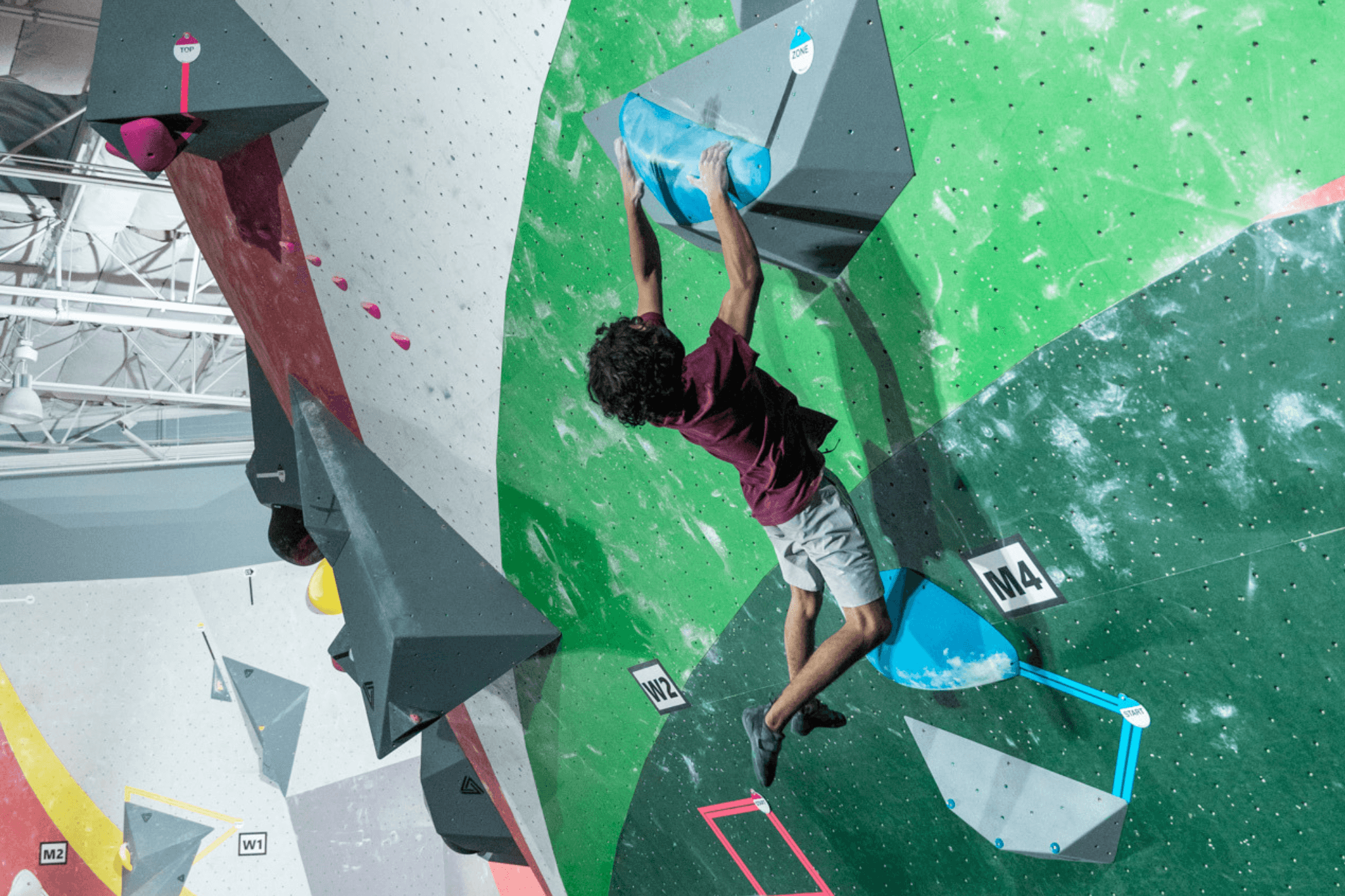
Competition Climbing 101
By: Kat Ku
Updated NOV 3, 2026
Published APR 3, 2024
Competition climbing, or "comp" climbing as it's often called, has been on the rise in the last few years, especially since the sport made its Olympic debut back in 2020. You may have seen comp routes in your gyms and athletes crush at live events, but you might be wondering, "How exactly does competitive climbing differ from the rock climbing I'm used to?”
This guide goes back to the basics, so that you can be (almost) as knowledgeable as the judges the next time you’re watching an IFSC (International Federation of Sport Climbing) World Cup or cheering on your favorite athletes during the Olympics this summer. Or perhaps you’re considering putting your own skills to the test at a local comp! Either way, we’re breaking things down to simplify the mystique surrounding comp climbing.
{}{}null{"default_text":"group","slides":"group","slideshow_settings":"group","styles":"group"}null98459521332"@hubspot/image_slider_gallery"2[{"caption":"
Climbers tackling boulders during a qualification modified redpoint bouldering round. (featuring Movement Fountain Valley)
","img":{"alt":"Friction Series Qualifiers BS-66 (4)","height":1365,"src":"https://2699992.fs1.hubspotusercontent-na1.net/hubfs/2699992/Friction%20Series%20Qualifiers%20BS-66%20(4).jpg","width":2048}},{"caption":"Climbers on an overhang in modified redpoint round. (featuring Movement Sunnyvale)","img":{"alt":"377254542_800255458775230_4798466247323101347_n","height":1365,"src":"https://2699992.fs1.hubspotusercontent-na1.net/hubfs/2699992/377254542_800255458775230_4798466247323101347_n.jpg","width":2048}},{"caption":"Climber crushing in redpoint rope competition! (featuring Movement Portland)","img":{"alt":"361614640_791771369400948_4024808023702338308_n","height":1067,"src":"https://2699992.fs1.hubspotusercontent-na1.net/hubfs/2699992/361614640_791771369400948_4024808023702338308_n.jpg","width":1600}},{"caption":"Climber working a qualifier boulder while other competitors observe and figure out beta beta. (featuring Movement Sunnyvale)","img":{"alt":"Comp 101 Blog Zone Photo (1)","height":1365,"src":"https://2699992.fs1.hubspotusercontent-na1.net/hubfs/2699992/Comp%20101%20Blog%20Zone%20Photo%20(1).png","width":2048}},{"caption":"Competitor rules and regulations meeting ahead of a modified redpoint qualification round (featuring Movement Fountain Valley) ","img":{"alt":"Friction Series Qualifiers BS-100 (2)","height":1365,"src":"https://2699992.fs1.hubspotusercontent-na1.net/hubfs/2699992/Friction%20Series%20Qualifiers%20BS-100%20(2).jpg","width":2048}}][]"NOT_SMART""module""module""div"
Let’s start with different competition formats:
- Redpoint – Commonly used in qualification rounds, this format allows competitors to try a variety of climbs within a given timeframe. Each route is a different difficulty level, and climbers earn a commensurate number of points for completing each route. Athletes are assigned a certain block of climbs to try for their category and have unlimited attempts.
- Modified Redpoint – As the name suggests, modified redpoint slightly different version of the format described above. Overall, it's often utilized in community and youth comps to create a more accessible, friendly, and efficient experience. For example, the number of attempts allowed per climb may be limited or athletes may not be limited to an assigned block of climbs to try.
- Onsight – Think IFSC finals – onsight format is usually reserved for championships or finals. Competitors are not allowed to watch other climbers and spend time in isolation when they are not climbing. In certain competitions, athletes are allowed a brief preview period to look at the climbs at the start of the round. preview climbs or discuss beta and will have a fixed amount of time to attempt to top each climb.
- Usually, in bouldering, scores are determined by the following factors in descending order: number of tops, number of zones, attempts to achieve tops, and attempts to achieve zones. More on this later!
- In rope climbing, each hold on the route corresponds to a point, so the climber that reaches the highest hold earns the highest hold in the round.
- Flash – You'll probably see this format a lot less. Competitors receive pre-recorded beta and can watch their opponents’ attempts. However, they are only allowed a single attempt on a route within a set time limit.
{}{}null{"default_text":"group","slides":"group","slideshow_settings":"group","styles":"group"}null98459521332"@hubspot/image_slider_gallery"2[{"caption":"Finalist looking for control of a \"zone\" on a finals boulder. (featuring Movement Fountain Valley)","img":{"alt":"Comp 101 Blog Zone Photo","height":1365,"loading":"disabled","size_type":null,"src":"https://2699992.fs1.hubspotusercontent-na1.net/hubfs/2699992/Comp%20101%20Blog%20Zone%20Photo.png","width":2048},"link_url":{"no_follow":false,"open_in_new_tab":false,"rel":"","sponsored":false,"url":{"content_id":null,"href":"","type":"EXTERNAL"},"user_generated_content":false}},{"caption":"Climber moving from a four point start. (featuring Movement Santa Clara)","img":{"alt":"369724625_839924571475431_607271092176142765_n","height":1365,"src":"https://2699992.fs1.hubspotusercontent-na1.net/hubfs/2699992/369724625_839924571475431_607271092176142765_n.jpg","width":2048}},{"caption":"Climber controlling the \"top\" of a boulder in a finals round. (featuring Movement Santa Clara)","img":{"alt":"400334346_839926508141904_1577977544725814739_n","height":1365,"src":"https://2699992.fs1.hubspotusercontent-na1.net/hubfs/2699992/400334346_839926508141904_1577977544725814739_n.jpg","width":2048}},{"caption":"
Sport climbing finalists figuring out beta during preview period (featuring Movement Portland)
","img":{"alt":"361885227_791774192733999_4866810156775103895_n","height":1067,"src":"https://2699992.fs1.hubspotusercontent-na1.net/hubfs/2699992/361885227_791774192733999_4866810156775103895_n.jpg","width":1600}},{"caption":"
Climbers sizing up a finals boulder during the preview period. (featuring Movement Fountain Valley)
","img":{"alt":"Friction Series Finals KK-185 (1)","height":1365,"src":"https://2699992.fs1.hubspotusercontent-na1.net/hubfs/2699992/Friction%20Series%20Finals%20KK-185%20(1).jpg","width":2048}}][]"NOT_SMART""module""module""div"
Now, let’s talk about some commonly used lingo you might hear from World Cup commentators or just around the gym.
- Four Point Start – Especially in finals, comp boulders typically have a four point starts, in which the starting positions of each of your 4 limbs are indicated.
- ISO – Short for isolation, this is an area where climbers are sequestered so they cannot obtain information about a climb before starting it. Typically used in onsight finals!
- Control – This is a term to describe when a climber uses a hold to achieve a stable position. Both hands must be on the hold!
- Top – Pretty self-explanatory! It’s when a climber reaches the final hold of a climb with control.
- Zone – A marked hold partway up a climb that grants competitors a certain number of points if controlled.
As you can probably tell, rules and regulations can vary from comp to comp, but hopefully this cleared up some of the intrigue! Maybe you’d even like to try your hand by competing in a local comp – it could be more rewarding and less daunting than you think! There’s still lots more to learn, so check back soon for strategies on how to perform your best at a comp!
Come climb with us! Find a Movement Gym near you.
Ready to start moving?
Join the community climbing, training, and growing at Movement.